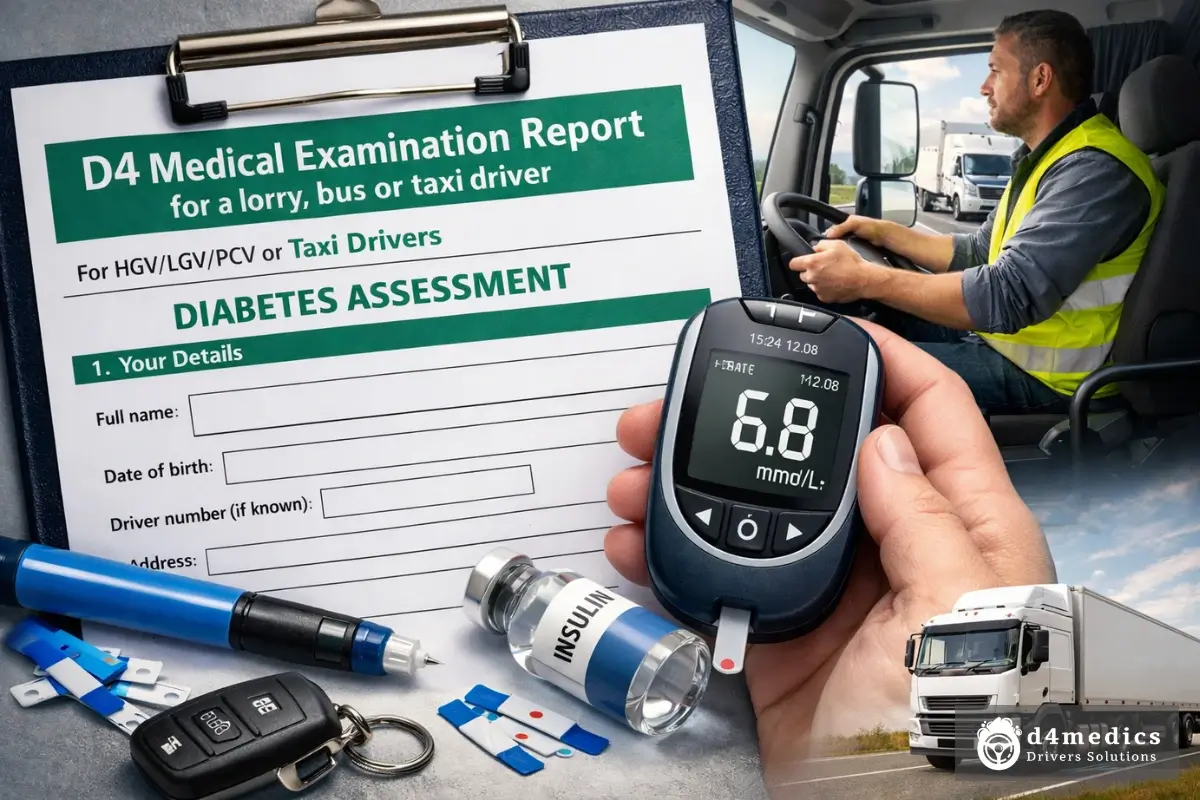
Managing diabetes does not end a professional driving career. Thousands of HGV, LGV, PCV, and taxi drivers across the United Kingdom hold valid licences while living with either Type 1 or Type 2 diabetes. The key to success lies in understanding the d4 medical form and how the DVLA evaluates diabetic applicants. This guide explains everything a diabetic driver needs to know about the d4 medical form, the clinical thresholds that determine medical fitness to drive, and the exact steps to pass the assessment.
The d4 medical form is the official DVLA document completed by a GMC-registered doctor. This form captures your medical history, current medications, and specific clinical measurements. For diabetic drivers, the d4 medical form carries additional weight because the DVLA requires proof of stable blood glucose control and freedom from severe hypoglycaemia. Failure to provide this evidence leads to a failed d4 medical and potential licence revocation.
Understanding DVLA and Diabetes Requirements
The relationship between dvla and diabetes is strictly defined in Group 2 licensing rules. DVLA and diabetes management protocols differ based on whether a driver uses insulin, oral medications, or diet control alone. The dvla and type 2 diabetes requirements are generally less strict than those for insulin-dependent drivers. However, dvla and diabetes type 2 still require annual notification if the driver uses certain medications like sulphonylureas or SGLT2 inhibitors.
DVLA diabetes type 1 represents the most regulated category. Drivers with dvla diabetes type 1 must complete a dvla diabetes type 1 form as part of their application. This dvla diabetes type 1 form requests detailed blood glucose readings, hypoglycaemia episode logs, and confirmation of regular eye screenings. Type 1 diabetes driving dvla rules mandate that a driver must demonstrate no severe hypoglycaemia episodes while awake for 12 consecutive months.
For dvla requirements for type 2 diabetes, the rules depend on the medication regimen. DVLA requirements for type 2 diabetes for drivers using insulin are identical to Type 1 rules. DVLA requirements for type 2 diabetes for drivers using metformin alone are minimal, requiring only self-reporting of stable control.
What is Tested in a D4 Medical for Diabetic Drivers
During the commercial driving medical, the doctor performs specific tests and asks targeted questions related to diabetes. Understanding these elements allows a driver to prepare appropriately.
- Blood Glucose Review: The doctor examines your blood glucose meter or logbook. For insulin-dependent drivers, you must provide a minimum of 2 months of readings showing at least two tests per day and before every driving session.
- Hypoglycaemia History: The doctor asks about any episodes of severe hypoglycaemia requiring assistance. A single severe hypo while awake within the last 12 months results in a failed d4 medical.
- HBA1C Measurement: The doctor reviews your recent HBA1C result. Levels above 86 mmol/mol (10% DCCT) raise concerns about unstable control and trigger a DVLA review.
- Diabetic Eye Screening: The doctor confirms you have attended annual diabetic eye screening. Proliferative retinopathy or maculopathy requiring laser treatment leads to a 12-month driving ban.
- Peripheral Neuropathy Check: The doctor tests sensation in your feet. Loss of protective sensation affecting pedal control causes immediate disqualification.
- Medication Review: The doctor lists all diabetes medication and driving relevant drugs. Insulin, sulphonylureas, and glinides carry hypoglycaemia risk and require stricter monitoring.

DVLA Medical Form Diabetes: Completing the D4 Correctly
The dvla medical form diabetes section of the D4 requires precise answers. The dvla medical form diabetes asks about diagnosis date, medication type, hypoglycaemia frequency, and hospital admissions. Any inconsistency between the dvla medical form diabetes and your medical records triggers a formal DVLA investigation.
When completing the dvla medical form diabetes, follow these rules. Declare every medication. List every hypoglycaemia episode, even mild ones. Provide your NHS number so the DVLA can verify your diabetic eye screening attendance. Omitting information on the dvla medical form diabetes constitutes a criminal offence under the Road Traffic Act.
The dvla diabetes medical form also asks about driving patterns. You must confirm you test your blood glucose within 2 hours before driving and every 2 hours during long journeys. The dvla diabetes medical form requires a signature confirming you understand the legal duty to stop driving immediately if hypoglycaemia symptoms appear.
Driving With Insulin Dependent Diabetes
Driving with insulin dependent diabetes carries the strictest regulatory burden. Driving with insulin dependent diabetes requires a dvla driving medical diabetes assessment every 1 to 3 years, depending on your control stability. The rules for driving with insulin dependent diabetes changed significantly in recent years, with the DVLA now accepting continuous glucose monitor (CGM) data as evidence.
Insulin dependant driving rules state that a driver must maintain a blood glucose reading above 5.0 mmol/L before driving. Insulin dependant driving rules also require testing every 2 hours during a journey. If a reading falls below 5.0 mmol/L, the driver must stop, consume fast-acting carbohydrate, and wait 45 minutes before retesting.
Insulin dependent diabetes and driving becomes unsafe when hypoglycaemic unawareness develops. This condition means the driver experiences no warning symptoms before blood glucose drops to dangerous levels. Insulin dependent diabetes and driving with unawareness is prohibited. The DVLA revokes the licence until the driver regains warning symptoms, a process requiring specialist diabetes team supervision.
Insulin dependent diabetes driving records must show no severe hypoglycaemia episodes requiring third-party assistance. A single paramedic attendance or emergency glucagon injection resets the 12-month clock for insulin dependent diabetes driving eligibility.
DVLA Health Requirements for Diabetic Professional Drivers
The dvla health requirements for diabetic drivers focus on preventing sudden incapacitation. The dvla health requirements state that any episode of severe hypoglycaemia requiring assistance while driving leads to an automatic 12-month revocation. The same dvla health requirements apply to drivers who experience a hyperglycaemic emergency, such as diabetic ketoacidosis (DKA) or hyperosmolar hyperglycaemic state (HHS).
The dvla health requirements also mandate annual diabetic eye screening. Proliferative diabetic retinopathy triggers a dvla driving medical diabetes review. If laser treatment is required, the driver faces a 12-month ban from Group 2 driving. After this period, an ophthalmologist must confirm stable vision meeting the 6/7.5 standard.
For dvla health requirements related to kidney function, drivers with end-stage renal disease requiring dialysis are generally disqualified from Group 2 driving. The physical demands of commercial driving cannot be met while attached to dialysis equipment. A successful kidney transplant with stable function for 12 months may restore eligibility.
DVLA Driving Medical Diabetes: The Clinical Science
The dvla driving medical diabetes assessment rests on solid epidemiological evidence. Studies demonstrate that drivers with diabetes who maintain stable glucose control have accident rates no higher than non-diabetic drivers. Conversely, drivers with recurrent severe hypoglycaemia have accident rates five times higher than the general driving population.
The dvla driving medical diabetes protocol uses HBA1C as a proxy for overall control. An HBA1C above 86 mmol/mol indicates erratic glucose management and frequent high blood sugar excursions. These excursions often precede hypoglycaemic episodes due to overtreatment. The dvla driving medical diabetes doctor looks for a stable HBA1C between 48 and 69 mmol/mol as evidence of safe control.
DVLA medical fitness to drive diabetes determinations also consider medication compliance. Drivers who miss insulin doses or skip blood glucose tests cannot demonstrate the consistency required for dvla medical fitness to drive diabetes. The doctor assesses the driver’s understanding of carbohydrate counting, insulin adjustment, and sick day rules.
How to Book D4 Medical for Diabetic Drivers
Knowing how to book d4 medical as a diabetic driver requires choosing a clinic familiar with Group 2 diabetes protocols. When you book d4 medical, ask the provider if they have experience completing the dvla diabetes medical form. Not every GP practice understands the specific documentation required for insulin-dependent drivers.
To book d4 medical successfully, gather the following documents before calling. Your blood glucose meter or 2 months of printed logs. Your latest HBA1C result. Your diabetic eye screening report from the last 12 months. A list of all diabetes medication and driving relevant drugs with dosages. Your dvla diabetes type 1 form if you have already started the application.
To book a d4 medical, use a specialist provider like D4 Medics who focus exclusively on commercial driving medical assessments. These clinics understand the dvla requirements for type 2 diabetes and the stricter dvla diabetes type 1 protocols. When you book a d4 medical with a specialist, the doctor knows exactly which clinical details the DVLA requires on the dvla medical form diabetes.
To book d4 driver medical, call ahead and confirm the appointment length. A standard commercial driving medical takes 20 to 30 minutes. A commercial driving medical for an insulin-dependent diabetic driver may require 45 to 60 minutes to review logs and complete the dvla diabetes medical form.
Diabetes Medication and Driving: What the Doctor Checks
Diabetes medication and driving interactions receive close scrutiny during the D4 medical. Diabetes medication and driving safety depends on the drug’s hypoglycaemia risk profile. The doctor categorises diabetes medication and driving into three risk levels.
- High Risk (Insulin, Sulphonylureas, Glinides): These drugs cause hypoglycaemia. Drivers must demonstrate twice-daily testing, pre-driving testing, and 2-hourly testing on journeys. A single severe hypo trigger failed d4 medical.
- Medium Risk (SGLT2 Inhibitors): These drugs cause euglycaemic diabetic ketoacidosis. Drivers must understand sick day rules and ketone testing. Hospital admission for DKA triggers a 12-month ban.
- Low Risk (Metformin, DPP4 Inhibitors, GLP1 Agonists, Pioglitazone): These drugs rarely cause hypoglycaemia alone. Drivers on these medications alone face fewer restrictions but must still declare dvla and diabetes status on the d4 medical form.

Failed D4 Medical Due to Diabetes: Recovery Pathwaywhat is a d4 medical
A failed d4 medical due to diabetes is not permanent in most cases. A failed d4 medical typically results from missing documentation, a recent severe hypo, or an elevated HBA1C. If you receive a failed d4 medical, follow this recovery pathway.
- Request Written Explanation: Ask the doctor for a detailed letter stating exactly why you received a failed d4 medical. This letter guides your corrective actions.
- Consult Your Diabetes Team: Take the failed d4 medical letter to your diabetologist or diabetes specialist nurse. Ask for a treatment optimization plan.
- Complete the Stabilisation Period: For an HBA1C above 86 mmol/mol, spend 3 months intensifying glucose control. For a severe hypo, reset the 12-month clock with no further episodes.
- Regather Documentation: Collect 3 months of new blood glucose logs, a fresh HBA1C result, and an updated eye screening report.
- Book a New D4 Medical: Return to a specialist clinic with complete documentation. Most drivers who receive a failed d4 medical pass on the second attempt after proper preparation.
How to Pass a D4 Medical With Diabetes
The question of how to pass a d4 medical with diabetes has a clear answer: demonstrate stable, predictable glucose control. How to pass a d4 medical starts 3 months before the appointment. Test your blood glucose at least four times daily. Record every reading. Avoid any severe hypoglycaemia episode. Keep your HBA1C below 69 mmol/mol. Attend your diabetic eye screening. Take your diabetes medication and driving regimen exactly as prescribed.
How to pass a d4 medical also requires understanding the dvla health requirements specific to your diabetes type. A type 1 diabetes driving dvla applicant needs flawless logs and hypo records. A dvla and type 2 diabetes applicant on metformin alone needs only a stable HBA1C and no severe complications.
How to pass a d4 medical final requires choosing the right clinic. A provider like D4 Medics who specialises in driver medicals uk and commercial driving medical assessments understands the dvla medical fitness to drive diabetes standards intimately. They guide you through the d4 medical form, ensure every section of the dvla diabetes medical form is completed correctly, and help you avoid the common documentation errors that cause a failed d4 medical.
Diabetes Type vs D4 Medical Requirements
| Diabetes Type | Medication | Testing Frequency | HBA1C Target | Severe Hypo Rule |
| Type 1 | Insulin | 4+ daily + pre-driving | Below 69 mmol/mol | 12 months seizure-free |
| Type 2 | Insulin | 4+ daily + pre-driving | Below 69 mmol/mol | 12 months seizure-free |
| Type 2 | Sulphonylureas | Twice daily + pre-driving | Below 75 mmol/mol | 12 months seizure-free |
| Type 2 | Metformin Only | Self-monitoring as needed | Below 86 mmol/mol | No specific rule |
Final Words
DVLA and diabetes coexistence is possible for professional drivers who respect the rules. Driving with insulin dependent diabetes requires discipline but does not end a career. The d4 medical form is a tool for safety, not a barrier to work. Prepare your documentation. Stabilise your glucose. Choose a specialist clinic. Pass your commercial driving medical. Keep your licence. Keep driving.