
The DVLA Group 2 medical standard for epilepsy is among the strictest in vocational licensing and for good reason. A seizure at the wheel of an HGV, bus, or taxi carries consequences that extend far beyond the driver. For professional licence holders, the difference between a single unprovoked seizure and a diagnosed epilepsy condition can determine whether you return to work or face permanent disqualification from Group 2 driving. Many drivers ask: can you drive with epilepsy on a vocational licence? The answer depends on whether you have an established diagnosis or a single seizure event.
D4 Medics is a DVLA-approved, GMC-registered driver medical centre — not a GP surgery or general health clinic. We specialise exclusively in D4 medical assessments for HGV, LGV, PCV, taxi, and crane operator licence holders. Our role is to assess your fitness to drive against DVLA Group 2 medical standards and complete your D4 form accurately and compliantly — so your licence application is not delayed by paperwork errors. We do not provide treatment, referrals, or general health advice.
This guide explains exactly what the DVLA requires for epilepsy and Group 2 licensing, why the standards differ fundamentally from private car (Group 1) driving, what documentation can support an exceptional case, and when it makes sense to book your D4 appointment versus seeking specialist review first.
What the DVLA Group 2 Standard Actually Requires for Epilepsy
DVLA Group 2 standards — which apply to HGV (Category C, C+E, C1, C1+E), LGV, PCV (Category D, D+E, D1, D1+E), taxi, and crane operator licences — take a fundamentally different approach to epilepsy than Group 1 (private car) licensing. The threshold is not about managing risk; it is about eliminating it to the greatest extent medically possible.
The Core Standard
For Group 2 licensing, the DVLA position is explicit: an established diagnosis of epilepsy is a bar to holding a vocational licence. Unlike Group 1, where a 12-month seizure-free period can restore driving eligibility, Group 2 standards do not permit licensing once epilepsy is diagnosed — with only narrow, exceptional circumstances considered.
The distinction matters because many drivers confuse “a seizure” with “epilepsy.” The DVLA defines epilepsy as a tendency to recurrent, unprovoked seizures. A single seizure, depending on circumstances and specialist assessment, may not constitute epilepsy — but it will trigger investigation before any Group 2 certification is possible.
Understanding dvla epilepsy guidelines is essential before booking your assessment.
DVLA Epilepsy Standards Decision Table
| Condition / Scenario | DVLA Group 2 Requirement | Pass / Refer / Fail | What This Means for Your Licence |
| Established epilepsy diagnosis (recurrent unprovoked seizures) | Not permitted for Group 2 licensing | Fail | Cannot hold HGV, PCV, taxi, or crane operator licence. Must surrender Group 2 entitlement permanently unless exceptional case criteria met. |
| Single unprovoked seizure (no diagnosis of epilepsy) | Requires specialist neurologist assessment; typically 10-year seizure-free period for Group 2 | Refer | Examiner cannot certify. DVLA will seek specialist opinion. Licence suspended pending outcome (typically 12-26 weeks). |
| Provoked seizure (clear acute cause: alcohol withdrawal, metabolic disturbance, acute illness) | May be considered if cause resolved and low recurrence risk; specialist assessment required | Refer | Not automatic fail, but requires neurologist letter confirming cause was provoked and recurrence risk is minimal. |
| Nocturnal-only seizures (asleep-only, pattern established over years) | Exceptional cases considered with specialist evidence; typically 3+ years established pattern | Refer | Requires detailed sleep study and neurologist report. DVLA reviews case-by-case. Not guaranteed approval. |
| Medication-controlled epilepsy (on anti-epileptic drugs, seizure-free) | Still not permitted for Group 2 even if controlled | Fail | Being seizure-free on medication does not override the epilepsy diagnosis bar for vocational licensing. |
| Childhood epilepsy, resolved (seizure-free 10+ years, off medication) | May be considered with specialist evidence of resolved condition | Refer | Requires neurologist letter confirming epilepsy has resolved and recurrence risk is equivalent to general population. |
Why Group 2 Differs from Group 1
The DVLA’s stricter stance on Group 2 reflects the heightened risk profile of vocational driving. An HGV driver covers more miles, operates heavier vehicles, and carries greater responsibility for other road users. The At a Glance guide to the current medical standards of fitness to drive states plainly: the public interest in preventing a seizure-related incident involving a large goods vehicle outweighs the individual driver’s interest in holding a vocational licence.
For taxi and private hire drivers, the same standard applies despite shorter journey distances — because you are carrying passengers who cannot exit the vehicle mid-journey and rely entirely on your fitness to drive.
Pass, Refer, or Fail: What Happens at Your D4 Appointment With Epilepsy
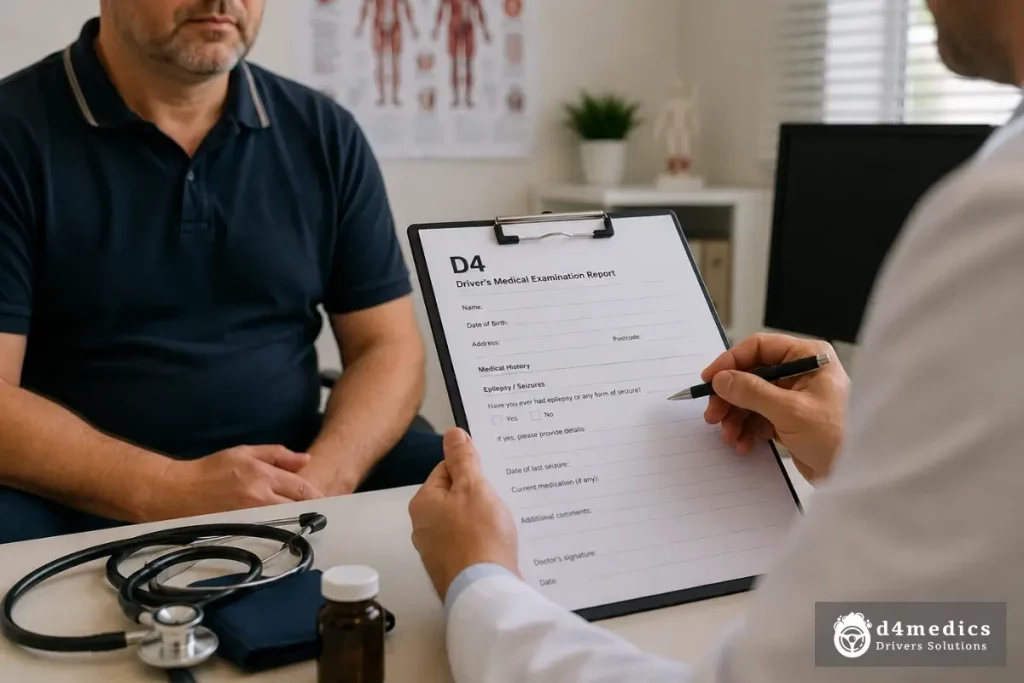
When you attend your D4 medical assessment, the examiner is not making a diagnosis. They are assessing whether you meet the DVLA Group 2 standard based on your disclosed history, documentation, and clinical examination. Epilepsy is primarily assessed through history and documentation — not through physical examination findings. The examiner assesses driving and epilepsy dvla standards based on your disclosed history.
The Decision Framework
If you have a diagnosed epilepsy condition: The examiner cannot certify your D4 form for Group 2 licensing. This is not a discretionary decision — it is mandated by DVLA standards. The form will either be completed for Group 1 only (if you hold that entitlement) or left uncertified for Group 2, with a referral note to the DVLA medical branch.
If you report a single seizure with no epilepsy diagnosis: The examiner will refer your case to the DVLA medical branch for specialist neurological assessment. You will not receive a signed D4 form on the day. The DVLA will contact your neurologist or request a specialist opinion, a process that typically takes 12-26 weeks. During this period, you cannot drive on your Group 2 licence.
If you have documentation of a provoked seizure with resolved cause: The examiner will still refer to the case, but the referral includes your supporting documentation (GP letter, hospital discharge summary, or specialist letter). This can shorten the DVLA review timeline, but certification is not guaranteed on the day.
If you have exceptional circumstances (nocturnal-only pattern, childhood resolved epilepsy): The examiner requires specific documentation before proceeding. A generic GP letter stating “seizure-free” is insufficient. You need a neurologist’s report addressing the specific DVLA criteria for your scenario. Without this documentation at the appointment, the case is referred, adding weeks to your timeline.
The Documentation That Determines Your Outcome
The difference between a same-day certification and a 20-week referral often comes down to what you bring to the appointment. For epilepsy-related cases, the examiner needs to see:
- Neurologist letter (not just GP letter) addressing the specific DVLA standard for your scenario
- Medication list if you are on anti-epileptic drugs (even if for other indications like neuropathic pain)
- Hospital discharge summaries for any seizure-related attendances
- Sleep study reports if claiming nocturnal-only seizures
- EEG results if recently performed
A GP letter stating “patient is fit to drive” carries no weight for Group 2 epilepsy cases. The DVLA requires specialist neurological opinion because the standard is neurological, not general medical.
The Booking Decision: When to Book Now vs Prepare First
The decision most drivers face is not whether to book — it is whether to book now or wait until your neurological status is clarified with specialist documentation. Epileptic seizure and driving vocational vehicles is the core risk the DVLA seeks to eliminate. In our experience, drivers who arrive with a single seizure history and a neurologist letter addressing DVLA Group 2 standards typically progress through the referral process more efficiently than those who arrive with only a GP letter. Drivers who arrive with an established epilepsy diagnosis and no specialist documentation face an inevitable referral that costs 12-26 weeks, not just the £60 appointment fee.
Here is what to bring and when to book:
Book now if:
- You had a single provoked seizure (e.g., alcohol withdrawal, acute illness) over 12 months ago, have no ongoing symptoms, and have a discharge summary confirming the cause
- You had childhood epilepsy, have been seizure-free and off medication for 10+ years, and can obtain a neurologist letter confirming resolved status
- You are renewing your licence and have no seizure history to declare
Wait and seek specialist review first if:
- You had a single unprovoked seizure within the last 12 months and have not yet seen a neurologist
- You have been diagnosed with epilepsy but believe your case meets exceptional criteria (nocturnal-only, etc.) and need specialist documentation
- You are currently on anti-epileptic medication and have not had recent neurological review
Do not book if:
- You have an active epilepsy diagnosis with recent seizures (within 12 months) and no exceptional circumstances
- You are awaiting neurological investigation for a recent seizure
- Your GP has advised you not to drive
The cost of booking prematurely is not just the appointment fee — it is the weeks or months added to your licence timeline while the DVLA seeks the documentation you should have obtained before booking.
Common Misconceptions About Epilepsy and the D4 Medical
| Common Belief | The Reality | Why It Matters |
| “If I’m seizure-free on medication, I can pass my D4 medical.” | For Group 2 licensing, an epilepsy diagnosis is a bar to licensing regardless of seizure control on medication. This differs fundamentally from Group 1 standards. | Drivers who book believing medication control is sufficient face an inevitable fail and waste their appointment fee. They need specialist review to explore exceptional case criteria first. |
| “My GP says I’m fit to drive, so I’ll pass the D4.” | GP opinions do not override DVLA Group 2 standards for epilepsy. The DVLA requires specialist neurological assessment for any seizure history. | Arriving with only a GP letter triggers a referral that adds 12-26 weeks to your timeline. A neurologist letter addressing the specific DVLA standard is required. |
| “One seizure doesn’t mean I have epilepsy.” | While technically correct, a single unprovoked seizure still disqualifies you from Group 2 licensing until specialist assessment confirms low recurrence risk — typically requiring 10 years seizure-free. | Drivers who fail to disclose a single seizure risk licence revocation for non-disclosure. Those who disclose face referral but avoid the far more serious consequence of driving without valid entitlement. |
| “If my seizure was at night, I can still drive.” | Nocturnal-only seizures may be considered in exceptional cases, but require 3+ years of established pattern and specialist sleep study evidence. It is not automatic approval. | Drivers who assume nocturnal seizures are exempt from disclosure face licence revocation. Those who disclose without proper sleep study documentation face lengthy referral delays. |
| I can just book a D4 medical and see what happens. | Booking without understanding dvla driving and epilepsy medication requirements wastes your fee and adds weeks to your timeline. | Drivers who book d4 driver medical appointments without first securing neurologist documentation face inevitable referral delays. |
| “I can reapply once I’m seizure-free for a year.” | The 12-month seizure-free rule applies to Group 1 (car) licensing, not Group 2. For vocational licences, the standard is typically 10 years seizure-free for a single unprovoked seizure. | Drivers who wait 12 months and then apply for Group 2 face rejection. Understanding the correct timeline prevents wasted applications and prolonged time off the road. |
What Happens After the D4 Exam: From Referral to DVLA Decision
If your D4 assessment results in a referral due to epilepsy or seizure history, the process shifts from the examiner to the DVLA medical branch. Understanding this timeline helps you plan for time off work and manage expectations. This process follows dvla guidelines and epilepsy referral protocols.
The Referral Timeline
Week 1-2: The examiner submits your D4 form with a referral note to the DVLA. You receive no certification on the day. Your Group 2 licence entitlement is suspended pending the medical review.
Week 3-8: The DVLA medical branch contacts your neurologist or requests a specialist opinion. If you have not provided a neurologist letter, this is when they seek one. Delays occur if your specialist is slow to respond or if additional investigations (EEG, sleep study) are requested.
Week 9-16: The DVLA medical adviser reviews the specialist evidence against Group 2 standards. For epilepsy cases, this often involves senior medical review because the decision carries significant livelihood implications.
Week 17-26: You receive a decision letter. Outcomes are: (1) Group 2 licence refused due to epilepsy diagnosis; (2) Group 2 licence approved under exceptional case criteria; or (3) further information requested, extending the timeline.
During this entire D4 medical process, you cannot drive on your Group 2 entitlement. If you hold Group 1 (car) entitlement and meet those standards, you may drive privately but not vocationally.
Can You Appeal a Refusal?
Yes, but the grounds are limited. You can request a review if you believe the DVLA misapplied the standard or if new medical evidence emerges. You cannot appeal simply because the refusal causes financial hardship — the standard is fixed, and the medical adviser’s role is to apply it, not to weigh individual circumstances.
For drivers with exceptional cases (nocturnal-only seizures, childhood resolved epilepsy), the appeal process typically involves obtaining additional specialist evidence that directly addresses the DVLA’s concerns. A generic “fit to drive” letter will not succeed.
Conclusion
Epilepsy and Group 2 licensing are, in most cases, mutually exclusive. The DVLA’s position is clear, consistently applied, and grounded in the heightened risk profile of vocational driving. For professional drivers, this reality is difficult — but understanding the standard before you book your D4 medical prevents wasted appointments, prolonged referrals, and unnecessary time off the road.
If you have a seizure history, the critical question is not whether you can pass the D4 medical — it is whether you have the specialist documentation that addresses the specific DVLA Group 2 standard for your scenario. A neurologist’s letter, sleep study results, or evidence of resolved childhood epilepsy can make the difference between a 20-week referral and a streamlined assessment process.
D4 Medics appointments take 15–20 minutes. The booking takes less. If you have epilepsy or seizure history, bring your specialist documentation — it is what determines your outcome, not the appointment itself. Schedule your D4 medical at d4medics.com/online-booking →